‘The Kiss and the Slap’; UML Review
Urban Media Lab gave us a taste of architecture; a double-edged sword. ‘A kiss and a slap.’ The studio, our new home, is a bubbling hub for making things but also a vacuum for sleep. It is an incredible feeling to be constantly surrounded by people who are just as passionate as you are about what you love, but with that, dissonance is inevitable.
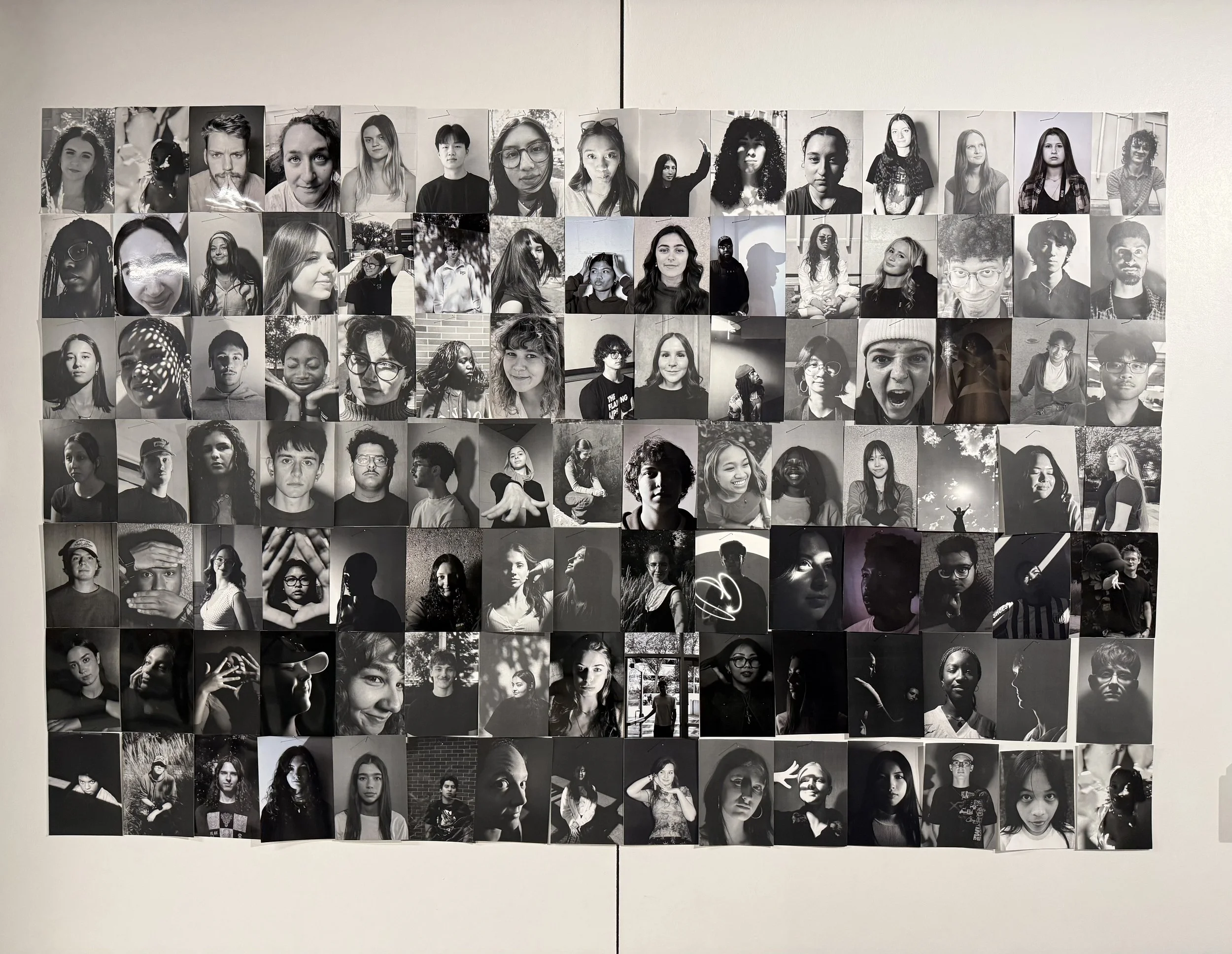
Yesterday we wrapped up Urban Media Lab, a mandatory two-week program we have to take before starting the faculty of architecture at U of M. We had a mixer last night presenting our work, which consisted of photography, drawings, models, and stellar portraits of every single one of us. Afterwards, I went off with close friends to further celebrate all that we managed to accomplish in such little time. We looked back on the stress, laughs, arguments, and memories we made among ourselves and others students we hardly knew two weeks ago.
Fascist undertones aside (of course), while prepping, I kept thinking of Marinetti’s futurist manifesto, in which he expresses,
“We want to exalt movements of aggression, feverish sleeplessness, the double march, the perilous leap, the slap and the blow with the fist.”
We discussed this quote in a visual communications course I took earlier this year, and we contrasted the slap against ‘the kiss.’ Despite their opposition, both are quick, chill-inducing acts of passion that press against the side of our face. Urban Media Lab gave us a taste of architecture; a double-edged sword. A kiss and a slap. The studio, our new home, is a bubbling hub for making things but also a vacuum for sleep. It’s such an incredible feeling to be constantly surrounded by people who are just as passionate as you about what you love, but with that, dissonance is inevitable.
I posted some of the drawing exercises we worked on (rightfully titled as ‘exercises of futility’). But along with that, we also made countless models and iterations – our new favourite word – and remixes of said models; both individually and as groups. My first group project was a gong show; all five of us had our own ideas of what our glue-and-tape free cardboard model should look like, and very foolishly, we started creating anyway without an actual plan (you can imagine the rest). By the end of the second week, the eight-foot-tall iterations we had built as groups of twenty were disassembled, and on the morning of our exhibition, we used their pieces to rebuild a singular, harmonious wall out of differently vernacularized groups of pieces.
What came of this was a large, intimidating wall of curves, columns, and exposed joinery made of wood and cardboard. I am certain that to others, our wall might have looked like jumbled scraps. But for me, I saw the confusion, excitement, and tension of working as a group under pressure. The euphoria of having your idea become real (concepts becoming things!) and watching an idea you love be discarded and mogged by a much cooler one are both integral parts of making. The kiss and the slap. Looking at our wall, I saw pieces of cardboard that we accidentally decorated with dents from our knees because we had to kneel onto the cardboard to cut and score it precisely. I saw some moments of scoring that slightly veered off, unintentionally causing our columns to have interesting gestural moves of line. I saw some of the errors and miscalculations that my friends and I made and kept secret from the rest of the group. The exhibition that I so excitedly anticipated over the last two weeks was a giant pointer to the labour we endured, not just the result of it. I was expecting a shiny, polished object to present to our friends and family, but what I ended up being most eager to talk to them about was the polishing, refinement, and collective iteration it took to get there.
‘Beauty Will Save the World’?
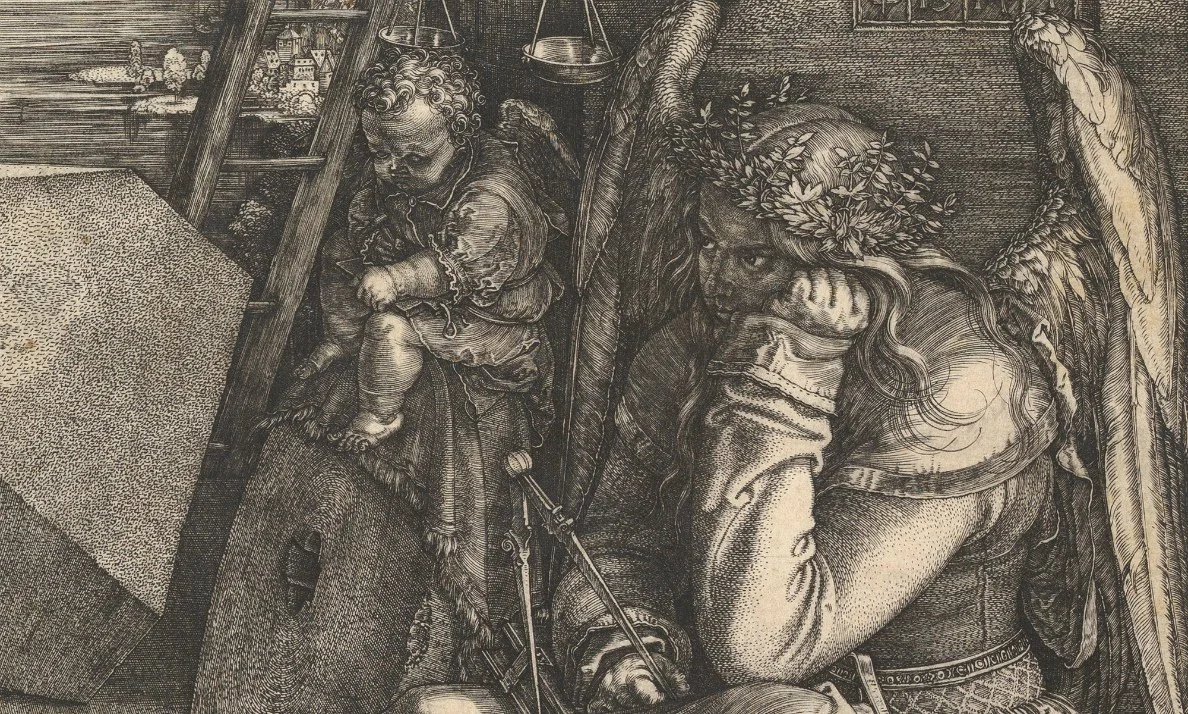
Pictured on the thumbnail is Albrecht Dürer’s Melencolia I; an artwork which has become an allegorical portrait of myself as i’ve been stepping into this new chapter of my life. The winged designer in the portrait is surrounded by scientific tools and paraphernalia and is seemingly frozen in contemplation; an understandable motif for the renaissance period. Similarly, Ive been paralyzed in anticipation over my incoming start of the faculty of architecture. I’m walking away from the humanities and towards a more stem-adjacent field where stress is a certainty. The dream of doing architecture and design clashes against this stale, profit-worshipping zeitgeist that design students like me are unlucky enough to be a part of.
Pictured on the thumbnail is Albrecht Dürer’s Melencolia I; an artwork which has become an allegorical portrait of myself as I’ve been stepping into this new chapter of my life. The winged designer in the portrait is surrounded by scientific tools and paraphernalia and is seemingly frozen in contemplation; an understandable motif for the Renaissance period. Similarly, Ive been paralyzed in anticipation over my incoming start of the faculty of architecture. I’m walking away from the humanities and towards a more stem-adjacent field where stress is a certainty. The dream of doing architecture and design clashes against this stale, profit-worshipping zeitgeist that design students like me are unlucky enough to be a part of.
I think my fellow classmates - whom I’ll meet tomorrow - feel the same as I do; we’re all excited, terrified, overwhelmed, we want to be singular poster children of awe, inspiration, and jealousy to our peers, but also all feel like we’re behind compared to everyone else. When I asked a local architect for advice for the faculty and my future career, he told me to “loosen-up” and to “have faith.” This instantly reminded me of ‘The Idiot,’ one of Dostoyevsky’s novel which I read over this crazy summer. Reading this book actually changed my perspective on life, and thus design. Before reading, I knew I’d have to tackle Dostoevsky’s assertion that ‘beauty will save the world’ and though it’s only explicitly said twice in the entire book, this assertion undergirds the whole story.
Prince Myshkin’s character, a Christlike figure thrown into late nineteenth century Russia, fully explores what it would look like for a truly ‘beautiful soul’ to exist in our world. ‘Beauty will save the world’ is never said by him throughout the novel, but other characters - Ippolit and Aglaïa - mention in passing that this is something he proclaimed more than once. (Spoiler Alert) Myshkin doesn’t even get close to saving the world, let alone his circle, but maintains the same feverish faith in humanity and beauty throughout the entire novel. It could be said that this pursuit of beauty is what saves his world from becoming like the wretched worlds of the other characters. Similarly, I know that ahead of me lies lopsided power dynamics, unpaid internships, all-nighters, and more hardships I won’t mention, but I can’t wait to experience it all. This year has been so crazy for me. What should have been the worst summer of my life became a much-needed reset and reconfiguration. Being so open and vulnerable (with this website, for example) allowed me to feel in ways I just couldn’t before. With faith, I decided to relentlessly look towards a world where my hardships are worthwhile, while also feeling the process as much as I can.
As for the things I learned in school, unlike the intro architecture courses from my first year, taking Art history and other humanities courses allowed me to zoom-in on the micro rather than the macro. I’m thinking of the film course I took in which I had to write 500+ words for a single one-second shot, my professor in an art history course who made us examine the same painting for 2 hours and made us write as much as we possibly could about said painting, and the same professor, without giving any hints, telling us to find our ‘blind spots’ with said papers on the painting. My devotion to examining art and its praxis across different cultural and historical contexts leads me to believe that ‘beautiful things’ have the capacity to change society or at least lead us to question our status-quos.
Ironically, I can’t help but to think of Taylor from The Yearbook Committee’s call for the destruction of Art, which I feel compelled to believe in despite the intense love for art/art history which i’ve fostered over the past year or so. He puts it this way:
“When I talk about art and my desire to destroy art, I’m talking about a narrow form of art which emerges with the renaissance, and which may have already ended, right? This historically specific period of bourgeois Art. That’s not to say that a transformation of society beyond bourgeois society wouldn’t have what I would call, instead, aesthetic objectifications, that we would turn the world… transform the world into objects of aesthetic pleasure and objects of beauty. That in fact, I think that we would endeavour to turn the entire world into a beautiful object. But, [Art] happening as this narrow thing that you put on the wall of a gallery, like, we should get rid of that, right? That most of the world is ugly and awful, and then you walk into the rarified space of the gallery where you could get a glimpse of beauty, a glimpse of what the world could be. That rather than art being that, the world would be the beautiful object, the world would be beautiful.”
I’ll say this again, is this not a casting call for architects? We, the actual designers of the future, should believe that this could be our role in this incredibly unique position that we are in. This world in which ‘beauty’ is mostly confined to approximations on our screens - and often, said beauty isn’t even made by us - is in need of ‘big’ changes. I know that i’m not the only person who yearns for this, and, as Mies Van De Rohe puts it “Architecture is the will of an epoch translated into space.” I’m talking big about a macro beauty/art despite having virtually no means to accomplish this proposal - again, I haven’t even started the program of environmental design yet - but I can’t have much else but feverish faith that this pursuit of beauty could ‘save the world,’ and if not, I will carry myself as though it has the capacity to do so anyway.
Link to The Yearbook Committee’s video
Urban As A Verb
it sucks that whenever we — and I mean guys that look like me — do anything that’s genre-bending or that’s anything, they always put it in a rap or urban category, which is — I don’t like that ‘urban’ word. That’s just a politically correct way to say the n-word to me.” he said.
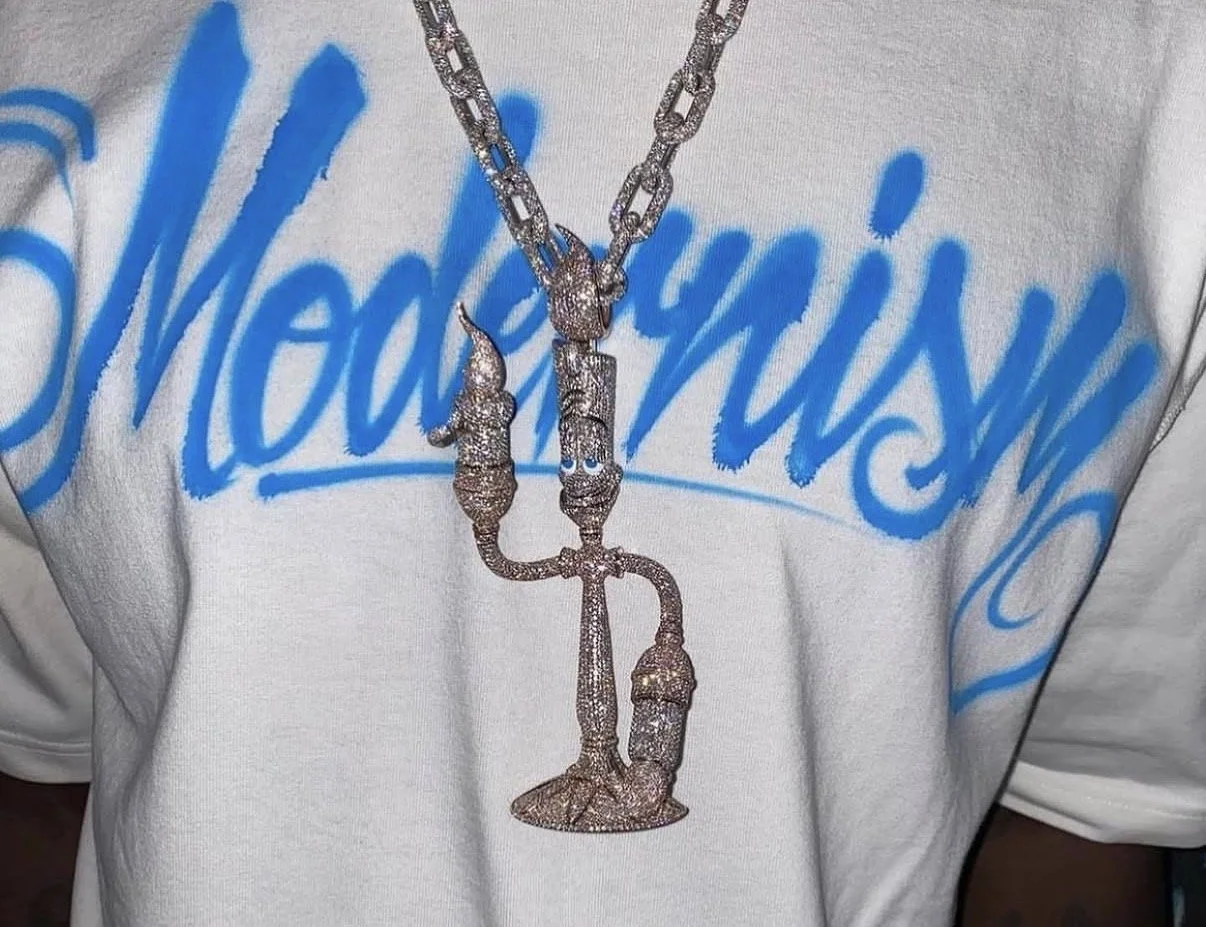
Not too long ago, I was rewatching “Insert Complicated Title Here,” one of my favourite lectures from Virgil Abloh. I credit Virgil for giving me the courage to pursue art and design, and he proved to millions like me that black art can not only make its way to the ‘upper echelon’ of design, but can also become canon. In the lecture, he asks, “what if streetwear was an architecture movement?” I interpreted this question more broadly as “what would it look like for ‘urban’ - it should go without saying that urban/streetwear are code words for ‘black’ - aesthetics to be at the forefront of art and architecture?” In trying to find precedents and a baseline for what this “streetwear”/“urban” movement would look like, my relation to this word ‘urban’ shifted and became something else entirely. Max Alfert wrote that “Considering its effect on modern Western art, the traditional art of black people must now be regarded as a major contribution to human culture in general.” This statement is apparent in the case of abstraction, which, as I will show, is indebted to the Urban ‘philosophy’ and creative pursuits of black people across the globe.
‘Urban’ artists from Africa and their artifacts were the genesis of modern art in the West. Primitivism, the German Die Brücke movement, the French’s Fauvism, among a myriad of other modern movements, were greatly influenced by artefacts found (and often stolen) from then-colonized West African countries. Despite European artists disregarding or out-right denying the sway that these African artworks had on their imagination – the influence, be that direct or circuitously, is sometimes undeniable. This unabashed concern of expression by means of colour, exaggerated form, and an interest in abstracted, more-than-human subject matter, de facto clashed against the status quo of monotonous academic art coming out of Europe. Positing themselves as antinationalist through their anarchist and self-proclaimed anticolonial worldview, these European avant-garde artists looked to adopt (but really, appropriated) “exotic” aesthetics from countries under colonial rule as protest against bourgeois culture; in so, completely missing their own ethnocentric attitude, fetishization, and their colonial-reminiscent extraction of resources from ‘tribal’ places.
Primitivism’s commodification of a mystical, idealized version of African aesthetics and traditions (particularly in parts of modern-day Congo and Benin) parallels the French zoos in which Congolese and Dahomean ‘priests’ and ‘witch doctors’ were put on display as entertainment and as props for propaganda. This intentionally pushed narratives of white supremacy in order to ‘rationalize’ colonial projects. In an attempt to segregate and hierarchize blackness from whiteness – and by violently inhumane means - the former’s ‘urban-ness’ was extracted in order to benefit the ladder. Despite an attempt to counter the dehumanization seen in the Human Zoos and other horrors of colonialism, the chief accomplishment of Primitivism and other movements was that they managed to bolster “canonical” art through their appropriation of black aesthetics.
What I’m trying to show is that Black aesthetics is reduced to the ‘urban category’ despite its documented influence on design as we know it. The abstracted art of the late nineteenth century and onwards is the direct result of the West coming across our art. American Architecture is also indebted to us, as ‘Negro hires’ - that is, slaves hired for construction projects - were common for campuses and government buildings such as the White House and the US Capitol building. Another example of black creativity speckled in American architecture can be traced out in wrought iron fences; ironwork gates and fences were often influenced or made by ironworkers from Cote D’Ivoire, Sierra Leone, and Ghana, who were sent to America as slaves. The designs and motifs incorporated into these iron fences – called adinkra – were symbols of status and/or funerary symbols; the most common (which you would not have to look too far to find) is the Sankofa, which almost looks like a heart and means “go back and fetch.” This is yet again an example of bastardized ‘urban’ design seamlessly assimilated into the West’s identity.
Earlier I mentioned Virgil’s achievement of putting his work and artistic vision at the forefront of luxury fashion. Virgil was the creative director of Menswear at what is arguably the biggest fashion house ever, and yet, words like ‘streetwear,’ ‘urban,’ and ‘hip-hop’ are the adjectives of choice in describing what he makes (like in 2022 when he was given an award for “Best Hip-Hop Fashion designer, what does that even mean??). Tyler, The Creator succinctly echoes my grief over the word ‘urban’ and its negative connotation. In 2020, he won his first ever grammy for his album Igor. Despite the album being more of a Pop record than anything else, the album won under the category of “Best Rap Album.” To this he said,
“On one side, I’m very grateful that what I made could be acknowledged in a world like this, but also, it sucks that whenever we — and I mean guys that look like me — do anything that’s genre-bending or that’s anything, they always put it in a rap or urban category, which is — I don’t like that ‘urban’ word. That’s just a politically correct way to say the n-word to me.” he said.
Let’s rid ourselves of the word ‘urban’ as an adjective and start thinking of it as a way to describe what we do. In doing this, we still need to ask ourselves where does this Urban-ness come from (and what this word would look like through this lens). That, I can’t answer alone, but I have an idea of where it we can find it at its highest. Ryan Coogler powerfully gesticulates the continuity of black music in his 2025 film, Sinners, through its “I Lied To You” sequence. What this sequence points to is the similarities between Afro-American art and art directly from Africa. The wisdom-packed storytelling of black music rhymes with what the Griots of West Africa do, the call and response we hear in ‘urban’ hit songs or in the black church follow the structure of the centuries-old funerary hymns that I grew up singing (Nyimbo za Wokovu), the loud evocative percussions of twenty-first-century rap music echo the drums of masquerades across the continent, the polyrhythmic flows of rap and Jazz are directly tied to West-African traditions brought to America through Slavery, and the dissonance of blues, I’ll say, is the apparition of our Urban-ness in spaces in which we were not supposed to exist in.
To clarify, I’m not laying a theological argument that our ‘urban-ness’ comes from God. Rather, I believe it may be inextricably tied to our posture of looking upwards; be that to God, the future, the supernatural, or other possibilities – as seen in the African masks and carvings which were stolen by Europe. Our capacity to keep this posture despite the heinous history inflicted upon us is what makes our art unparalleled to others. A year ago, for an art history course I wrote an essay on Arthur Jafa’s akingdoncomethas, a one-hundred minute film which compiles black performances in the church; each filled with intense or subdued black expression, in so, evoking a true and raw sense of the divine. This film has been the singular force in redefining my relation to black art. T. Jean Lax says this about the film.
“Just as ecclesiastical architecture, with its vaulted ceilings and plays of light, encouraged a leap of faith through the seeing eye, the black church (“the church of the insurgent”) has envisioned the possibility of human transcendence under captive conditions through a listening ear and the embodied word.”
To this, I’d also like to mention how hard this film goes when you consider the fact that none of it was supposed to happen. People who look like me weren't supposed to be on this side of the world, we weren't supposed to worship this god, and we weren't supposed to be thrown to the side and made into a homogenized group of peoples called "black," let alone survive. But someway, somehow, we carried the very tools that were meant to destroy us with unparalleled grace and swagger.
I say all of this to posit this “urban” word as an intrinsic design philosophy of Black people. I see it as a complex, unique, and incredibly immense umbrella of vernaculars born out of impossible hardships and unbound creativity, rather than a belittling and segregating adjective. When I say it’s a verb I mean that it’s something we do, not who we are. Because of our unique positionality across the globe, no one else in the world could ever do this Urban thing that we do. Black artists and their art have been the steam for Western imagination for the better part of half a millennia. A streetwear movement would be counter cultural, I admit, but would not be the only place where black aesthetics exist and thrive. This would presuppose that blackness is somehow beside the ‘status quo,’ but what I’m trying to show is that our contributions put us in the middle of it. So to answer Virgil’s question; I believe that our way of designing is already quite ubiquitous.
Sources:
Max Alfert, Relationships between African Tribal Art and Modern Western Art, https://www.jstor.org/stable/775542?searchText=max+alfert&searchUri=%2Faction%2FdoBasicSearch%3FQuery%3Dmax%2Balfert%26so%3Drel&ab_segments=0%2Fbasic_search_gsv2%2Fcontrol&refreqid=fastly-default%3Ae5bfb0fac64e4540374df240d7b19696&seq=1
Core Studio Public Lecture: Virgil Abloh, “Insert Complicated Title Here,” https://www.youtube.com/watch?v=qie5VITX6eQ
From Naming To Know, Slavery In Construction Projects, https://namingtoknowing.org/slavery-in-construction-projects/
Patricia Leighten, The White Peril and L'Art nègre: Picasso, Primitivism, and Anticolonialism, https://www.jstor.org/stable/3045764?workspaceFolderId=8902d2c1-7ae5-46bf-8341-1e0e1e9284b2&orderBy=updatedOn&orderType=desc&index=2&seq=1
Rolling Stone, Tyler, the Creator on His Grammy Win: It ‘Feels Like a Backhanded Compliment,’ https://www.rollingstone.com/music/music-news/tyler-the-creator-rap-grammy-backhanded-compliment-943568/
T. Jean Lax (MoMA), A Rehearsal for Communion: On Arthur Jafa’s akingdoncomethas, https://www.moma.org/magazine/articles/329
Yaatia Asabea, West African Symbolism in Ironwork Across the East Coast, https://vizcaya.org/beyond-vizcaya/west-african-symbolism-in-ironwork-across-the-east-coast/
How AI Could “Save” Art
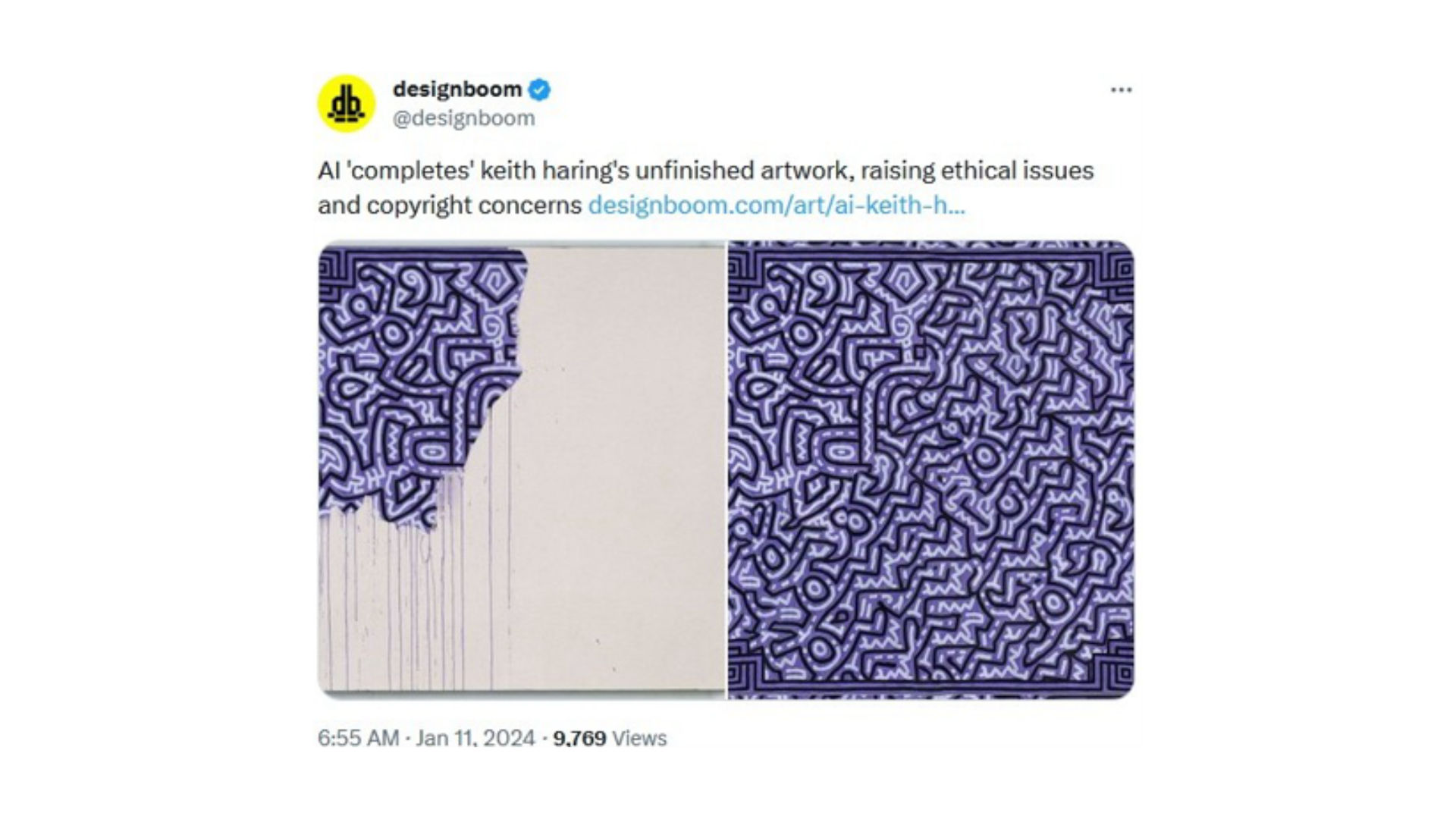
I’m not writing this cause I’m pro-AI, nor simply to be contrarian, but because AI is so ubiquitous that we virtually have no choice but to try and steer its positionality in Art towards the most ‘ethical’ direction. Believe me, I stand with the masses on this issue and pride myself in not using generative AI for anything. However, with a ‘medium’ – if we are willing to call AI such a thing – so fresh and pervasive, there is almost no limit to the ways in which we can stretch it and eventually destroy it from within.
I’m not writing this cause I’m pro-AI, nor simply to be contrarian, but because AI is so ubiquitous that we virtually have no choice but to try and steer its positionality in Art towards the most ‘ethical’ direction. Believe me, I stand with the masses on this issue and pride myself in not using generative AI for anything. However, with a ‘medium’ – if we are willing to call AI such a thing – so fresh and pervasive, there is almost no limit to the ways in which we can stretch it and eventually destroy it from within (as Greenberg claimed that we did with painting).
many people have already pointed out how ironically, AI’s use in art and design has de facto led to a growing appreciation for ‘human error’; something AI simply cannot replicate. With this, I want us to think about humanity’s innate meaning-making functions and consider how they seep into generative AI. Again, I am not endorsing face value generative AI slop art which is held together by bastardized folk art, I am talking about art that ultimately points us towards humanity, cost what it may. there could be other epiphanies on what it means to be human somewhere in our careful exploration of this contemporary “medium,” but I don’t know or claim to know what exactly these could be. Regardless, I don’t want to undermine the real impact that AI has on our lives and our planet, but my belief in humanity is so strong that I think AI will just be a hurdle in the grand scheme of Art and Humanity (we’re already seeing how repulsed the general public is by AI “art”) . Let the irony of the medium be its pedestal so that its message can reach the masses.
I have no interest in art that tries - or at least pretends - to be more than human. I’m talking about Art that puts itself at stake for its message because its intended message is that vital - I’m thinking of Sherrie Levine’s After Walker Evans, Marcus Harvey’s Myra, Arthur Jafa’s Ex-Slave Gordon, and many of Andy Warhol’s silkscreen artworks from the early 60s as I say this. We have made for ourselves a mirror which reflects the depth of our pride, bias, greed, discrimination, shallowness, predictability, cruelty, imagination, and imperfections; and I think it would be unwise to not entertain it for the sake of constructive reflection. I hate that this conversation even has to be opened and I wish this wasn’t something I have to consider as a design student but given where we are at right now (a literal wasteland of skeuomorphic, anthropomorphic interfaces contrasted against desaturating, over-corporate human expression), I think that there is at least a few artworks worth generating as we literally eat ourselves alive.
I have a ton of letters, drawings, and little notes left by my late sister that I keep in my room and hold dearly. I also have text messages riddled with typos from loved ones that I’ll never have conversations with again. When I look at these ‘artifacts’ (both digital and analog), in a way – which you would just have to know to understand –I can feel and see their reflection. By being immersed in, and bombarded with art history over the past year, I’ve realized that you can catch a glimpse of this unexplainable ‘design detail’ in any artwork, any artifact in any museum, and if you look close enough, you can even feel this humanhood – this mysterious residue which seeps into things - as you navigate through buildings; this is left by the architects’ conscientious and often vulnerable decisions. AI doesn't have any of this. Its lack of this is actually exactly what separates it from ‘real Art’ and exactly what it threatens to strip away from art and architecture. If AI art – this bubbling, superfluous, mendacious movement – is what it takes for people to realize what we’re losing, and in so, encourages us to magnify humanness in the Art we make and the overall design of our everyday lives, then I'm very excited for what the future entails.
Holding Space: A close reading of Jules Olitski’s “Harlow Flow”
In this essay I will closely read Harlow Flow, Jules Olitski’s 1963 painting. I will pay close attention to the right side of the painting to try and enunciate its ebullience and its internal conflict which Michael Fried’s Three American Painters essay speaks to in Olitski’s oeuvre more broadly.
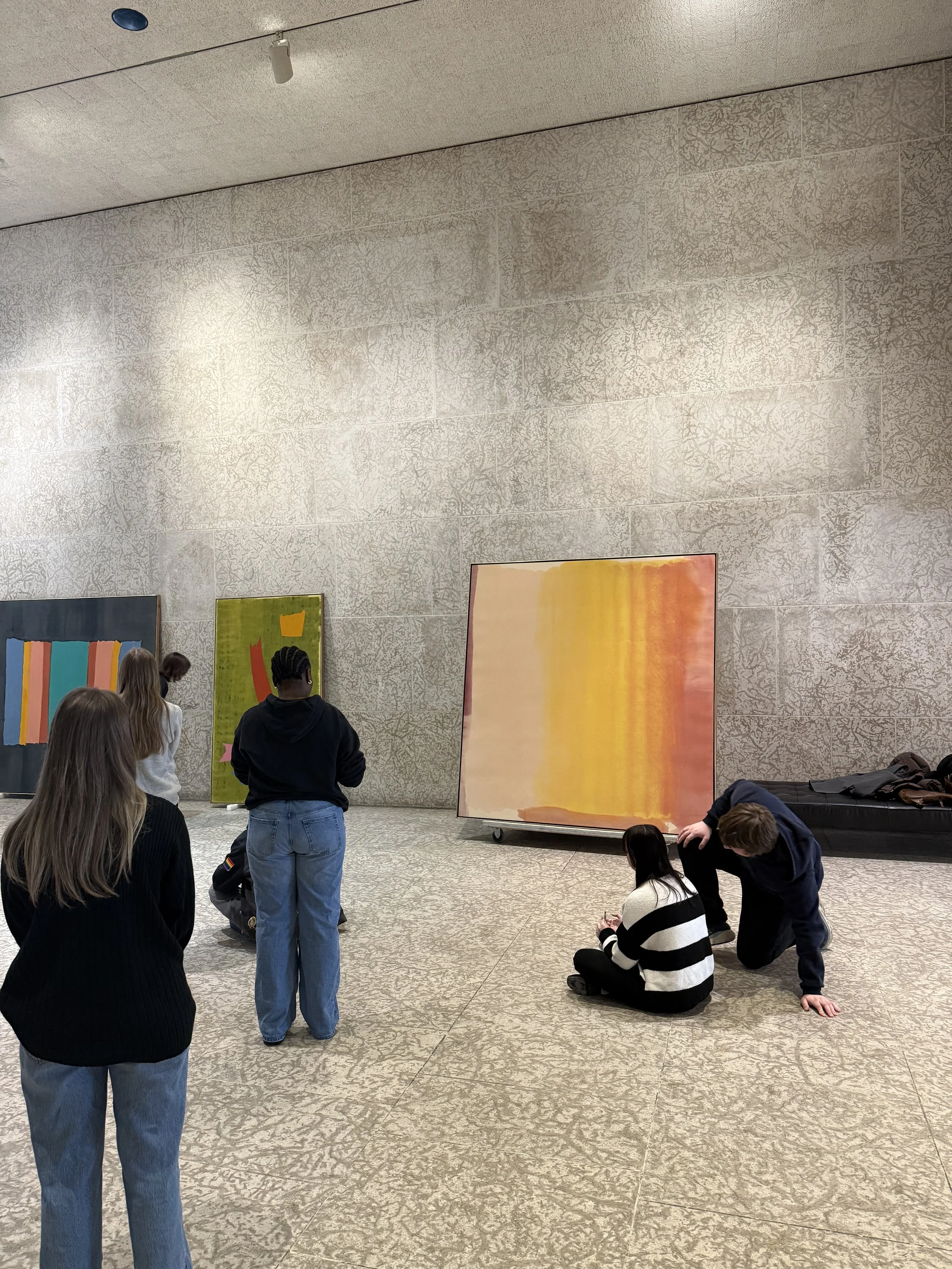
For our final field trip, our class was introduced to and dissected three mid-century modernist paintings from the Winnipeg Art Gallery’s archives. Kenneth Lochhead’s Night Green, Jack Bush’s Red Hook, and Jules Olitski’s Harlow Flow were the works we looked at and discussed, and in making them the backdrop of our conversations revolving mid-century modernism more broadly, the theme of these three artists negotiating their respective personalities into ‘major art’ recurred in our notes and conversations. In our previous essays, we had already investigated some of the values that may have been expressed and embedded in Lochhead’s paintings, and for Bush, we looked for traces of his background in advertisement which he seeks to ‘balloon’ into the category of high art. The most evident display of an internal conflict, in my opinion, was Harlow Flow. The painting’s saturated colours and prodigious presence struck me as a superfluous, multi-faced painting that embodies the spirit of many artists we looked at throughout our class lectures. I was enthralled, and admittedly a bit repelled by its potency and – as one of my classmates put it – how “disgustingly sentimental” it was. In this essay I will closely read Harlow Flow, Jules Olitski’s 1963 painting. I will pay close attention to the right side of the painting to try and enunciate its ebullience and its internal conflict which Michael Fried’s Three American Painters essay speaks to in Olitski’s oeuvre more broadly. The implications of Olitski’s negotiation between his personal convictions and of status quo modern painting are embodied in Harlow Flow’s appearance as well as the process which conceived it.
Harlow Flow has an overbearing presence. Its size definitely plays a role in this, but its true vulgarity comes through the intensity of the painting’s eloquent monochromatic colours, which are accentuated by the more ecstatic moments towards the right side of the paintings. On the left, Olitksi presents a gorgeous Rothko-Esque moment consisting of a flattened, floating, blush-colored orb hovering above a purple ‘landscape’ constructed by wet paint. Layers upon layers of paint formulate a sense of immensity, which is both countered and encouraged by the sharp, but never straight borders surrounding each colour. Its enormous size, surface flatness, and arbitrary form is overwhelming but not particularly needle-moving in the grand scheme of modernist painting. Seeing it in person, I was immediately reminded of my experience seeing Mark Rothko’s Number 16 (Two Whites, Two Reds) colour field painting in Montreal, and with time, Harlow Flow began to rhyme with some of the works of Morris Louis and Helen Frankenthaler, which I have not seen in person but am familiar with thanks to our extensive investigations throughout this class. This echoing of his contemporaries could be read as Olitski showing off his “advanced taste,” something that Fried rightfully identifies as an asset of Olitski’s, one which he often uses as a stool to reach for his convictions.
Like the paintings of Morris Louis, Harlow Flow wants to redefine its relationship between itself and time. Read from left to right, the painting speaks to the continual coloring and staining of its canvas. On the left we see the semi-translucent effects of wet paint, which seamlessly fades into heavy layers of paint, then pouring, and if we continue to read in this direction, we are led to a deconstruction of the painting’s formal aesthetic and coherence. On the right side, paint frees itself and overrules any previous sense of formal rigor found on its left. This, along with the severely stained backside of the canvas, become fossilized evidence of Olitski’s clinical process. Another example of time being teased can be seen below on the right side. Here, this grandiose accumulation of paint emulates, plays with, and defies what gravity does with time. The bottom of the yellow and orange section – decorated with lines of patina – hold and communicate a carnal sense of weight and suspension over the salmon-colored background, like heavy theatre drapes. It exudes a constant state of suspension, both as a gravitational surrender to attrition, as well as a tease to the picture’s own ‘uncovered’ potential. It could be said that here, Olitski acknowledges his ongoing negotiation between his own taste and that of his contemporaries by ‘covering’ his true convictions in the name of ‘formal painting.’
Tidal waves on the brink of splashing down are suspended high above the curtains, and between the two is an amalgamation of paint-perturbed canvas. Even though this space has been claimed by the yellow, in its dominion, the yellow’s only details are the results and consequences of the monotonous procedure which led it here. Beyond it, there are several lines of what looks to be creases, likely accumulated from the way in which the canvas was rolled. These lines emphasize the painting’s verticality, and the space that yellow holds compared to blush. Unlike the blush side of the painting, the right side’s edges are flared and undefined. Mirroring the blush corners which tease the hors-champ, the tidal waves and flares appear as though they are actively trying to occupy more space. The repetition expressed through the process of layering, the pours, and the constant rolling of the canvas all become the image itself. The tail begins to wag the dog as Olitski’s painting becomes a self-sufficient operation of pictorial occupation which only exacerbates its own dysmorphia.
Olitski’s desire to colonize the canvas with his own personal taste is clear. Just as Fried identifies in other Olitski paintings, Harlow Flow – through colors and form – strives to reach unearthed grounds, however the painting’s negotiation turns the canvas into a field of internal conflict and incoherence. This is because Olitski practically shoehorns his impulses onto and into the canvas in such a gross manner. The right side of Harlow Flow becomes a site for Olitski to claim as his, an opportunity to colonize space without building anything clear. His unfinished, continual desire to overthrow his own formal rigor is pictorially manifested, and it showcases his confusion and indecision, becoming the focal point of the painting. His ‘conviction’ does not lead him anywhere but in a position where he occupies arbitrary space. Despite Olitski’s evident awareness of corners which he communicates with the blush orb, the curtain and the tidal waves have a disseminating push to cover and occupy space inside and beyond the canvas. Michael Fried spoke about Olitski’s ability to repackage colours; he says that his level of saturation and articulations make colours feel ‘new,’ and in combining them, he creates interesting and unexpected colour dynamics. Fried says that this unity is comparable to Northern Renaissance paintings such as Jan Van Eyck’s Arnolfini Portrait, in that a clear, complex pictorial situation emerges out of otherwise arbitrary objects. In response to this, I would agree with Fried’s notion, but I would also say that Harlow Flow’s unity almost solely lies in that both worlds – advanced taste and conviction – share a canvas. Their internal conflict is not a dance nor music as Fried describes, but a continuously growing occupation, a colonial project in which the strives of Olitski’s acquisition for real estate becomes the picture itself, vandalizing the footprints of his peers in the name of self-gratification and exposure. The situation he communicates, one of perpetual expansion, is clear but void of depth in favor of claiming surface space.
A Case for Barnett Newman’s “Voice of Fire.”
“Art reveals to us our capacity for meaning making in the absence of traditional authority, in the absence of God, in the absence of some divine ordering of the world, art reveals to us that we are capable of being divine. We are capable of doing that which God previously did.”
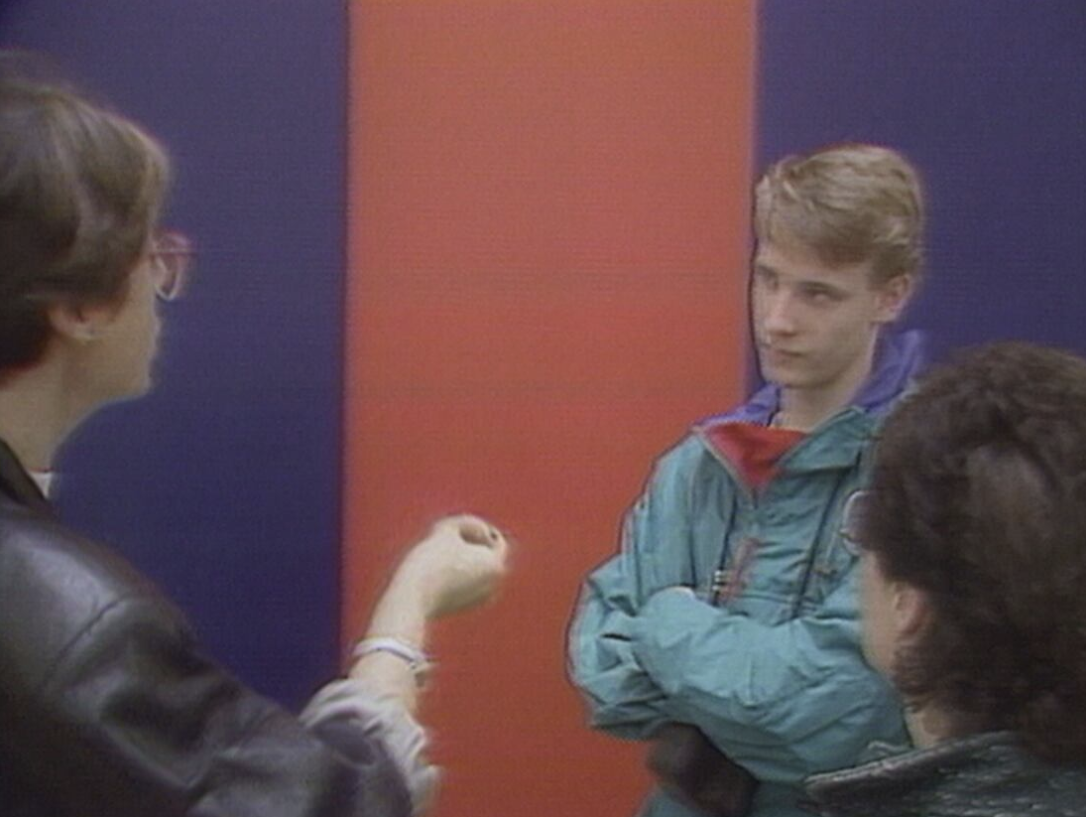
In March of 1990, The National Gallery of Canada purchased a striped, six by two metered red and blue painting for a measly 1.8 million dollars. The painting in question, Voice of Fire by Barnett Newman, was made in 1967 as part of Montreal’s Expo 67. You would think that this painting would be greeted with kindness upon its return to Canada, but its reception was quite the opposite. The great irony of the painting’s enthusiastic disavowal is that it speaks to the power of art. I would like to declare that this is one of the greatest painting acquisitions in Canadian history; its ability to elicit feelings among Canadians (whether positive or negative) by means of its simplicity is something worth celebrating and studying.
The painting is enormous. It consists of a blood-red center complimented and framed by deep navy blue. There are no explicit connotations behind the use of these colours, but their union to me felt heroic, luxurious, and a bit religious. It stretches over 6 meters in length, and because it is so strictly horizontal, it completely imposes over and dwarfs its viewer, commanding to be looked at as an ascension. In hindsight, its dominance by means of radical simplicity reflects Greenberg’s observation that “you feel as though you are in the presence of high art” when you confront Newman’s paintings. Another thing Greenberg noted was Newman's “Honesty” as well as his “Nerve and Conviction.” I find these three qualities in Newman’s certainty and courage to bring to life a painting that could have been incredibly mundane. This certainty is reflected in the calculated flatness of his colours and sharpness of his line, as well as the size (and consequential “volume”) of this work. This high praise that I, Greenberg, and others would like to give this painting might shock you, but believe me, you cannot rely on your phone or computer screen to simulate the experience of seeing this work in person. Regardless, the refusal for this painting to be taken seriously, I believe, does not discredit its power but actually confirms it.
Newman’s painting is alien compared to other abstract artists like Van Gogh, Picasso, and Manet, who aren’t necessarily ‘realists’ but their art still holds to a degree of representationalism (incidentally, each one of them has a handful of works at the NGC). Despite this, what they and Newman have in common is that their art is part of the shift in Western painting, a result of the advent of photography and the disembodiment of the bourgeoisie and the proletariat (this is further examined and interpreted in Greenberg’s Avant-Garde and Kitsch essay). The consequence of modernity for Western painting was that the practice had to become something new; it could no longer exist as it did before. The days in which painting was something to ‘trick us’; to mediate a sense of drama and hide its limitations through realism and calculated perspective to edify the church, were gone. Instead, painting had to make sense of itself, question its limitations, and reduce and/or add to its core components in order to enrich itself and remain relevant in modern culture. Instead of concealing painting’s flatness, its respective size, and other limitations, modern painting celebrated these aspects and embraced them into the picture itself. When speaking of Manet’s paintings, Clement Greenberg described his work as the first modern pictures due to “the frankness with which they declared the flat surfaces on which they were painted.” The practice of painting went from being a strictly religious tool dominated by elected ‘masters,’ to having nearly every aspect which made it what it was stripped away, and it never lost its mysticism and meaning-making abilities in the process.
Taylor from @theyearbookcommittee (link to their video below) describes this perfectly:
“Art reveals to us our capacity for meaning making in the absence of traditional authority, in the absence of God, in the absence of some divine ordering of the world, art reveals to us that we are capable of being divine. We are capable of doing that which God previously did.”
With this in mind, think about how Barnett Newman radically simplifies painting. His picture is simply two borders of opposing colours (or you can read it as one border repeated twice by mirroring itself). Yet, it still has the pictorial energy to elicit fear, angst, confusion, and other feelings. Like the minimalist movement which came very shortly after Newman, the painting has a degree of objecthood – that is, it seems to have its own totem-like agency or ‘voice.’ Voice of Fire doesn’t need a figure or face to confront and offend you; it just does. Its imposing presence that I spoke of earlier works despite its minimalism, in fact, it is implicitly from its minimalism that it strikes us. Newman plays with this idea in other ‘zip’ paintings like Vir Heroicus Sublimis and Who’s afraid of Red, Yellow and Blue, which exude a sense of bloated hubris simply through colour, size, flatness, and their titles; these things – which traditionally were arranged to exist beyond the realm of the flat picture – become the picture’s sole subject matter and voices. In the same way Newman reduces Voice of Fire to an irreducibly complex picture; I’d argue that he brings forth a defensive, animalistic reaction in people as though the paintings ‘objecthood’ is looking us in the eye. If the painting were bad, you wouldn’t be moved, but the fact that it causes outrage is the actual embodiment and confirmation of its power.
A reddit comment from a forum speaking of the painting says it better than I could “If art is made to elicit feelings, or spark discussion, I’d say the artist completely nailed it.” For the sake of fun, with all this in mind someone could maybe even draw a conclusion that there are hidden figures in Voice of Fire – that is, the angry public who almost have a degree of ‘Caravaggio-Esque’ drama in their reactions to this painting. There’s more to this painting that simply can't be explained. You have to go see it in person and feel its influence on your body. Newman’s painting is an unforgettable, moving piece of art, even if you find it to be offensive to some degree. Ask yourself how three stripes manage to give a lot of us a knee-jerk and almost primal sense of defensiveness. Consider the power that painting still has in spite of its disconnection from the ‘divine’. If it angers you, it’s good art.
Sources
Newman, Barnett. Voice of Fire, 1967. Acrylic on canvas. National Gallery of Canada.
https://csmt.uchicago.edu/glossary2004/objecthood.htm
Feeling is All; Art Chronicle (1952)
https://www.youtube.com/watch?v=LtL4VOWdG20&t=427s
What Will the Post-Truth Era Look Like for Architecture?
“… Is this not a casting call for architects? Imagine a world where we can explore, confront, and redefine billions of perspectives of knowledge, virtues, behavior, and the human condition through architecture.”
This text does not aim to precisely define what post-Truth architecture will look like. Rather, it's my personal opinions formulated upon research on post-Truth art, as well as prior knowledge stemming from my experiences with art history. Sources are mentioned in the text, but also available upon request.
We are living in the “post-Truth” era; the direct consequence of post-modernity, which can be broadly defined as the “death” of modernity and “Grand narratives.” Although “post-Truth” generally applies to politics, especially in the wake of “fake news,” and “Feelings-over-facts-” rhetorics, the result of this emerging zeitgeist is starting to spill into our daily lives. Artists have already begun to experiment with what this means for art, but there is virtually no talk on what the post-Truth era will look like for architecture. Do we, as architects, design our way back to a regressed, simplified way of life, championing (the now outdated) “Truth?” Or do we embrace the absurdism of a world where the concept of “truth” is archaic, and reality is subjective for each and every one of us? I’d suggest an alternative somewhere between these two extremes.
As precedents, we can look at examples of post-Modern art – let's call these examples Para-fictional experiences, as Carrie Lambert-Beatty puts it – to try and decipher how post-Truth might echo into architecture. In a Harvard VPAL event, Lambert-Beatty brings up Para-fictional art precedents, such as Michael Blum’s house museum titled "A tribute to Safiye Behar” (2005), which was an incredibly intimate gallery of “belongings” of a fictional character that Michael Blum invented. The point of this house museum was to touch the hearts of viewers and to build a connection between them and Safiye Behar, a controversial “freedom fighter”, whom here, is presented as someone we can relate to – although Safiye Behar never existed. With this, Blum humanizes people who carry differing ideologies which many would have otherwise overlooked.
Another example brought up by Lambert-Beatty is Coco Fusco and Guillermo Gomez-Pena's “Two Undiscovered Amerindians Visit the West,” (1992-93) in which they dressed as “Amerindians” undiscovered by Colombus and went on tour across Europe and the United States, making themselves a “human zoo”. This satirical performance piece directly confronted agency, voyeurism, the White gaze, White supremacy, colonialism, and orientalism, just to name a few. Here’s another: When Fred Wilson, an African American artist, was asked to do a presentation on African American art at the old Whitney Museum, he decided to do his own Para-fictional art piece. Before Wilson’s presentation, he shared lunch with the people who came to see him, left early, and instructed them to meet him at the gallery when they were done eating so that he could begin the tour. They made their way shortly afterwards, waited for him, and finally Wilson, who was dressed as a security guard the entire time, presented himself to them.
The driving force of these types of interventions can be defined as “epistemic friction.” They are incredibly powerful and pierce through problematic ways of seeing in a way which social media can never do. Jose Medina says that epistemic friction - through actual embodied encounters and specific events - can cause real disruptions that trigger the fracturing of one's “subjectivity”. Furthermore, I’ll add that these Para-fictional experiences in the real world are what is necessary to confront problematic, unilateral narratives associated with the “Grand narrative” of White supremacy. Confrontations like this are far too big to be projected onto our phone screens. Using a feelings-over-fact mantra, we can reveal the multifaceted face and nature of “Truth.” Medina also expressed his wish for society to be able to stimulate these kinds of events in our everyday lives. Is this not a casting call for architects? Imagine a world where we can explore, confront, and redefine billions of perspectives of knowledge, virtues, behavior, and the human condition through architecture.
With the death of the Grand Narrative, Post-Truth is our opportunity to implement decolonial strategies through architecture. Like post-modernism's championing of all eras, post-Truth architecture can usher ways of design otherwise seen as “primitive,” like the hundred/ thousand-year-old dwellings made by indigenous peoples across the globe, for example. I’d also add that this is our opportunity to use such “design languages” as tools for learning whilst also using them as they were intended to be used, not just pastiche spectacles for our gaze. When I say this, I think of traditional African masks used in certain areas of central, southern, and Western Africa, with peoples such as the Bobo, Bwa, and Mossi people of Burkina Faso, the Sande Society of Sierra Leone, The Dogon people of Mali, and the Nande people of Kongo, just to name a few. Each of the peoples that I mentioned have completely different uses for their masks, the only thing that they have in common is that they are not objects for our gaze. The “Truth” and supremacy of white-boxed, floor to ceiling windowed, modernist-influenced buildings will be behind us, and drown in a world clustered with a multitude of unique “Truths.” We are no longer confined to form over function and vice versa. Our technology allows us the freedom to explore feelings without compromising security, pastiche without bastardization, and homage without regression. As Jaime Hayon - an artist working to define post-Truth art - puts it, “it's about essence.”
I truly believe that post-Truth architecture has the ability to eliminate the myth of “status quo,” not through the destruction of the past, nor spangling itself in non-Western paraphernalia, but by building a rejuvenated future. We are at the apogee of post-Modernism's core values. I thank the post-Modernists for opening the door for these questions and visions to even be conceived, but it's our responsibility as post-Truth architects to walk through the door they opened for us and design new ones.

A Conversation with Colin Neufeld.
Earlier this year, I had the opportunity to visit the office of my favourite architecture firm. The firm in question, of course, is none other than 5468796 Architecture; Winnipeg’s very own world-renowned architecture firm created by U of M alumni Johanna Hurrme, Sasa Radulovic, and Colin Neufeld. While there...
Earlier this year, I had the opportunity to visit the office of my favourite architecture firms. The firm in question, of course, is none other than 5468796 Architecture; Winnipeg’s very own world-renowned architecture firm created by U of M alumni Johanna Hurme, Sasa Radulovic, and Colin Neufeld. While there, I spent the majority of my time interviewing Colin Neufeld, but I also had the chance to briefly speak with Ken Borton, Sasa Radulovic (our conversation exclusively consisted of two uses of the word “hello”), and Jae-Sung Chon, a professor in the U of M’s faculty of architecture.
During my time at 5468796’s office, I was given a detailed tour of their workspace, I got to see their collection of architectural models and sketches (some were made for cancelled projects, which was really cool to see), and I also got some thought-provoking answers to a series of questions I had prepared. Colin told me about some of the misconceptions of working in architecture, he gave me insight into his design process, and details about some of 5468796’s recent projects, such as the Pumphouse, 90/100 Alexander, and the Parkade of the Future in Calgary. When I asked him about his time in U of M’s faculty of architecture, he highlighted the importance of perseverance, putting every single one of your ideas on paper, and both he and Jae-Sung Chon emphasized the power of knowing when to step away from a project because “nothing is ever really finished.”
This visit was incredibly inspiring for me. I am very thankful to have had the opportunity to speak with such brilliant minds who just so happen to be alumni of my school. My conversations with Colin, Ken, & Jae-Sung sparked a light in me and showed me what’s possible for future architects, even in Winnipeg.